Powershoring as concept and practice
How clean energy abundance can reshape the geography of global industry
An ongoing project developed in partnership between the Net Zero Industrial Policy Lab (NZIPL), E+ Energy Transition Institute, and the University of Brasília
Summary of the concept
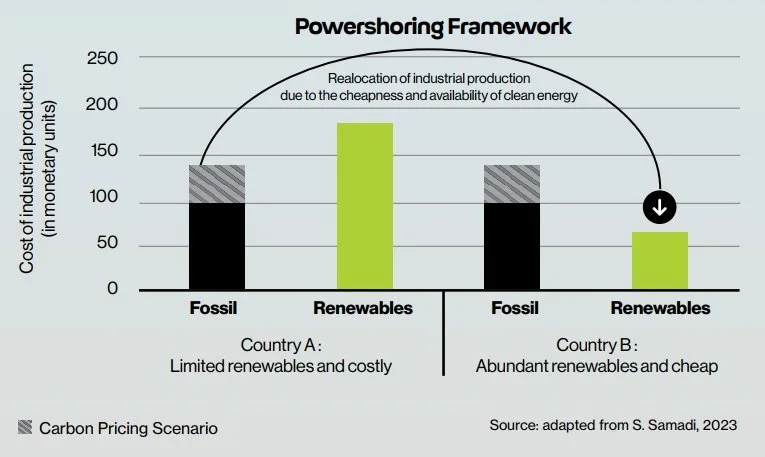
Based on the concept first formulated by Arbache and Esteves (2023), powershoring refers to the strategic relocation of energy- and resource-intensive industrial activities to regions that combine access to abundant, low-cost clean energy with proximity to key natural inputs. Unlike traditional offshoring — driven by cheap labour — powershoring is driven by the growing competitive advantage of clean, affordable electricity as a foundational input for modern industrial production.
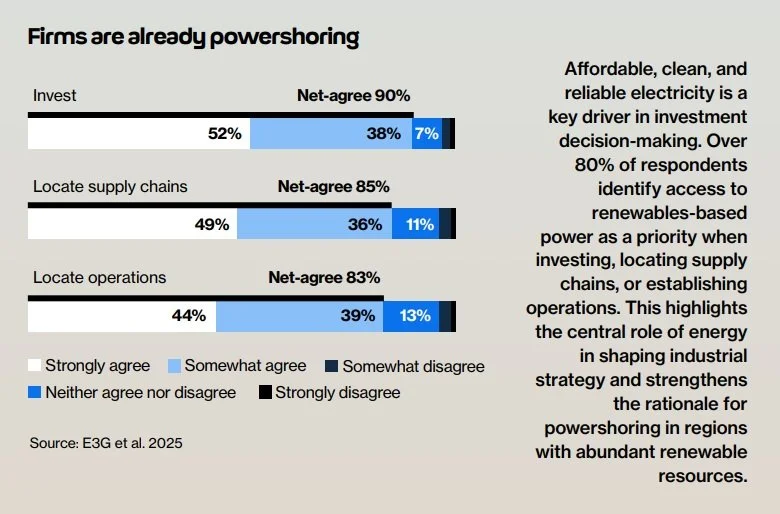
The concept rests on a straightforward but powerful premise: as climate regulations tighten, carbon pricing spreads, and geopolitical shocks fragment global supply chains, the geography of industrial production is being redrawn. Countries endowed with renewable energy at scale are increasingly attractive as hosts for energy-intensive manufacturing — not just as energy exporters, but as industrial platforms in their own right.
Powershoring operates along two main axes:
Low-carbon technologies — manufacturing products that enable decarbonization, such as solar panels, wind turbines, and batteries, in regions where the energy to make them is already clean.
Low-carbon goods — producing energy-intensive materials (steel, aluminium, silicon, fertilisers, chemicals) using clean electricity, dramatically reducing the embedded emissions of traded goods.
Because these opportunities are not evenly distributed across entire sectors, powershoring requires a microtargeting approach: identifying the specific value chain segments where a country's structural advantages — energy costs, natural resources, industrial base — can translate into durable competitive gains.
Brazil stands out as a model candidate. With nearly 88% of its electricity from renewable sources, world-class reserves of transition minerals, a diversified industrial base, and institutions capable of financing large-scale investment, Brazil is uniquely positioned to anchor energy-intensive, low-carbon manufacturing for global markets — and to move progressively up the value chain.
This project explores those opportunities in depth. The policy brief — available for download below — maps the pathways through which Brazil and other Global South economies can operationalise a powershoring strategy, with concrete sector analyses, policy recommendations, and financing frameworks. An academic paper, currently in preparation, will provide the full analytical and empirical foundations of the concept, including original modelling of competitive advantages across sectors and geographies.